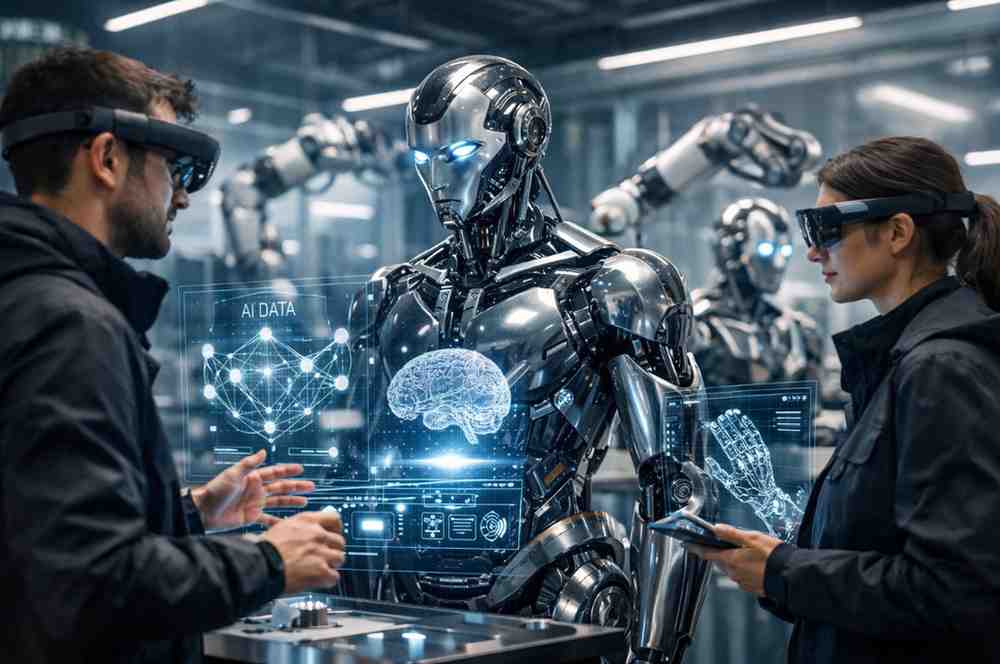
Robotics is one of the most transformative fields of modern science and engineering. It blends mechanics, electronics, computer science, and artificial intelligence to create machines that can sense, think, and act—sometimes alongside humans, and sometimes entirely on their own. From factory automation to surgical assistants and autonomous exploration rovers, robotics is rapidly reshaping how the world works.
But robotics is not just about machines. It is about expanding human capability.
What is Robotics?
Robotics is a branch of engineering and science focused on designing, building, programming, and using robots. A robot is typically a machine capable of carrying out tasks autonomously or semi-autonomously, often by interacting with its environment through sensors and actuators.
Modern robotics combines several disciplines:
- Mechanical engineering (structure and movement)
- Electrical engineering (circuits and power systems)
- Computer science (algorithms and programming)
- Artificial intelligence (learning and decision-making)
Together, these fields enable robots to perform tasks that once required human intelligence and precision.
A Brief History of Robotics
The idea of artificial beings has existed for centuries, appearing in myths and early mechanical inventions. However, modern robotics began to take shape in the 20th century with the rise of automation and computing.
The term “robot” was popularized by Karel Čapek in his play R.U.R. (Rossum’s Universal Robots), where machines were imagined as artificial workers.
Later, science fiction writer Isaac Asimov helped define the ethical foundation of robotics through his famous “Three Laws of Robotics,” which influenced how engineers approach machine intelligence even today.
Types of Robots
1. Industrial Robots
Used in manufacturing for welding, painting, assembly, and packaging. They are fast, precise, and tireless.
2. Service Robots
Assist humans in daily environments, including cleaning robots, delivery systems, and hospitality robots.
3. Medical Robots
Support surgeons in high-precision procedures and assist in rehabilitation therapy.
4. Exploration Robots
Used in extreme environments like deep oceans or outer space where humans cannot easily operate.
5. Autonomous Robots
Include self-driving vehicles, drones, and AI systems capable of independent decision-making.
Robotics and Artificial Intelligence
AI plays a crucial role in modern robotics by enabling machines to:
- Recognize objects and environments
- Learn from experience
- Make real-time decisions
- Adapt to changing conditions
Without AI, robots would remain limited to pre-programmed instructions. With AI, they become adaptive and intelligent systems.
Robotics in Industry
Industries worldwide rely heavily on robotics for efficiency and precision. Robotic arms handle repetitive tasks, improving productivity and reducing human error.
A major contributor to industrial robotics innovation is :contentReference[oaicite:0]{index=0}, known for developing highly advanced robots capable of dynamic movement and balance.
Robotics in Everyday Life
Robots are increasingly part of daily life:
- Home cleaning robots
- Smart assistants in devices
- Urban delivery robots
- Agricultural automation systems
This integration is making robotics one of the most influential technologies of the 21st century.
The DARPA Robotics Challenge
A major milestone in robotics development was the :contentReference[oaicite:1]{index=1}.
This competition encouraged robots capable of performing complex disaster-response tasks such as climbing, driving, and manipulating tools in hazardous environments.
Ethical and Social Questions in Robotics
As robots become more advanced, important questions arise:
- Should robots replace human workers in some industries?
- How do we ensure safe decision-making?
- Who is responsible for robotic errors?
- Can robots exceed human control?
These issues are central to the future of robotics development.
The Future of Work
Automation is reshaping employment. While some tasks are being replaced, new opportunities are emerging in robotics engineering, AI development, and system maintenance.
Robotics is increasingly seen as a collaborative tool rather than a replacement for human labor.
Humanoid Robots
Humanoid robotics focuses on machines designed to resemble humans. These robots may be used in caregiving, customer service, and companionship roles.
The goal is natural interaction between humans and machines.
The Future of Robotics
Emerging trends include autonomous vehicles, AI home assistants, medical nanorobots, space exploration systems, and emotionally responsive machines.
Robotics will continue evolving alongside society, reshaping daily life and global industries.
Conclusion
Robotics represents one of humanity’s greatest technological achievements. It blends imagination and engineering to create systems that extend human capability.
From early theoretical ideas to modern innovations by companies like Boston Dynamics, robotics continues to redefine how we live and work.